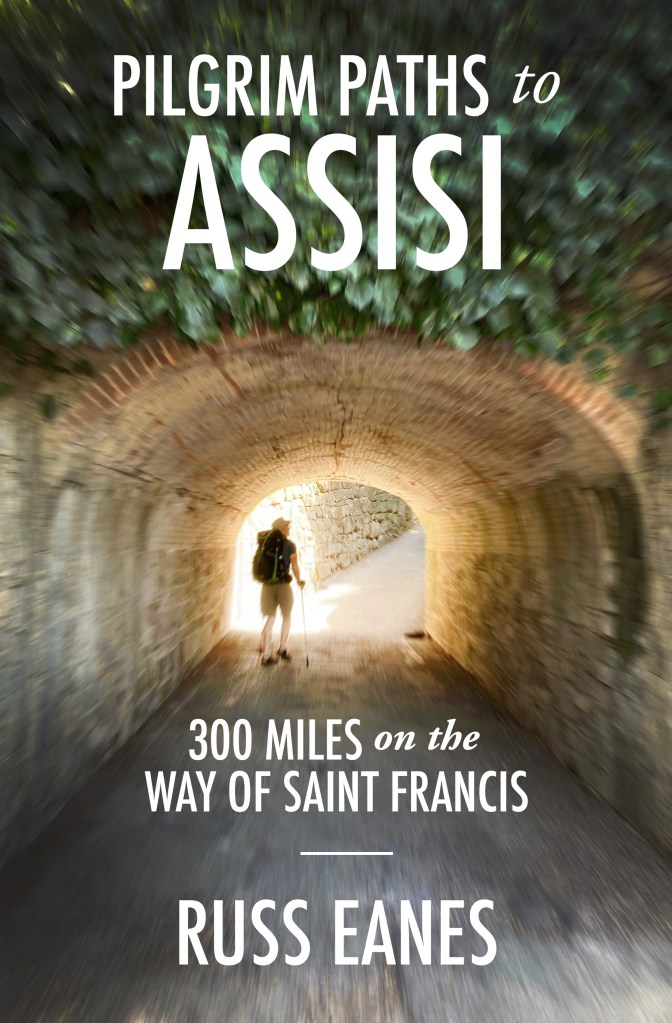
In my recent book about walking the Way of St. Francis, I share everything from facts to legends about this most-beloved saint’s life. I have found that many who walk on this route know little about him at all and that knowing a bit of his story makes this pilgrimage all the more meaningful.
In the book I also tell a bit about his life. My book’s introduction, offered here for free, sketches out the bare details . But equally important is why he matters today. As I reflected on my experiences and researched the writing of this book, three things stood out:
First, we need Francis and his faith more than ever. In an age of religious fundamentalism, we need his generous and gracious spirit. In a time of over-consumption that is despoiling and dangerously warming our planet—our only home—we need his reverence for the earth and his love for all humans and other creatures that inhabit it. His simple lifestyle points to the way out of our conspicuous over-consumption. His affection for and reconciliation to his hometown (and theirs to him) is an echo of hope into our fragmented and disconnected modern life. His non-violence is urgently needed in a world where there is too much warfare and far too much is spent on the military instead of for meeting basic human needs. My country—the United States—has more firearms than people, and mass-shootings are a daily occurrence.
Second, we need to walk more than ever. Walking bestows numerous health benefits—physical, mental, emotional, and spiritual. I live in a culture where many are unhealthy because of sedentary lifestyles. The average U.S. citizen walks less than two miles per day; our ancestors walked between eight and ten. Walking can help reduce weight, reduce cholesterol and lower blood pressure, increase bone density, boost moods, and improve brain health.1 I find walking or hiking with others to be a healthy social practice, while walking alone helps to settle and clarify my thoughts. Being outside in nature is one of the simplest and cheapest things that any of us can do to improve our overall well-being. And if we walk to the store—it will even reduce our dependence on fossil fuels.
Lastly, we need real experiences more than ever. During the pandemic I heard repeatedly that “virtual” i.e., online experiences, were our future. Forget the office, forget the school, go online. I don’t agree. We need actual experiences, with others—physical experiences. We need physical activity and social engagement with each other. Western society is addicted to screens, with the resultant negative consequences. Just this month a new twist on technology is all the rage—ChatGPT. I hear that it will make writing—and writers—obsolete. Someone asked me, humorously, why I didn’t ask it to write this book for me. My answer is simple: I love to write and I hope to get better at it, even though I am well into my 60s. It is one of my favorite creative outlets. I will continue to write, to walk, and to write about walking as long as I can.
I close with these words from writer and farmer, Wendell Berry. “My wish is to live my life as fully as I can. In both our work and our leisure, I think, we should be so employed. And in our time this means that we must save ourselves from the products that we are asked to buy in order, ultimately, to replace ourselves.”2
What a Franciscan sentiment.
(From the Afterword to Pilgrim Paths to Assisi.)
Notes:
- New England Journal of Medicine Study, 2001.
- Wendell Berry, What Are People For? p.190
Copyright © 2023 by Russ Eanes
Russ Eanes is a writer/walker/cyclist from Harrisonburg, VA and the author of Pilgrim Paths to Assisi: 300 Miles on the Way of St. Francis and The Walk of a Lifetime: 500 Miles on the Camino de Santiago.


You must be logged in to post a comment.